
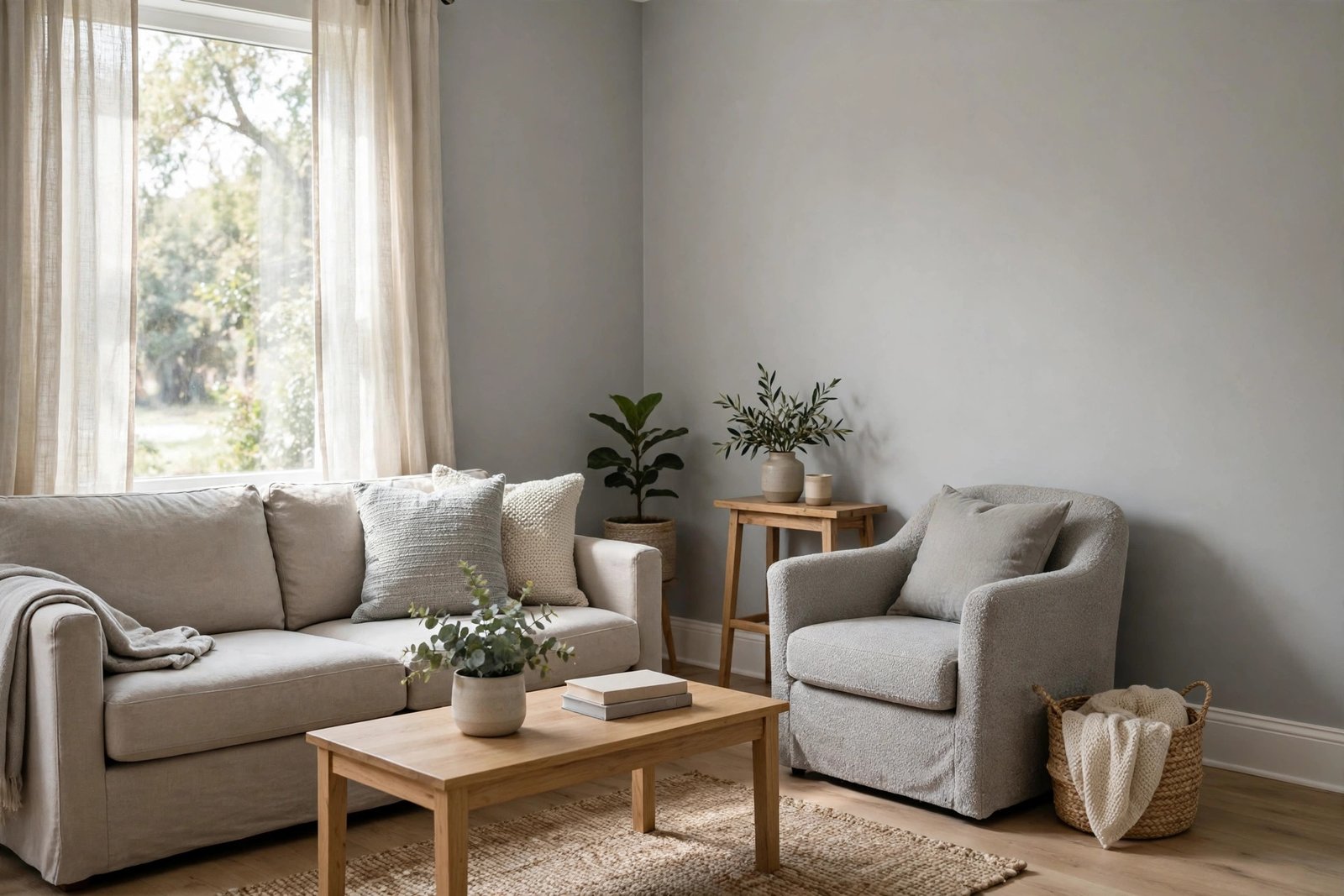
Quick answer: There’s no honest flat price for painting a living room, because living rooms vary more than any other room: the price follows the size of the room, whether it’s walls only or the ceiling too, how much trim, built-ins and feature-wall work is involved, and how big a colour change you’re making. A compact living room with one coat over a similar colour is a quick job; a large open-plan living room with a high ceiling, a feature wall and a dark-to-light change is a different job altogether. Either way, you get an exact, written price before any work starts.
The 7 things that set the price
1. Living room size — and open-plan layouts. A small, separate living room has far less wall than a large open-plan space that flows into the dining area or kitchen. Open-plan rooms also mean long, unbroken walls and more cutting-in where the living room meets the next space, and the quote reflects the full area being painted, not just the room’s name.
2. Walls only — or the ceiling too. Living room ceilings are often the first thing people notice once the walls are fresh, especially in rooms with high or vaulted ceilings. Fresh walls make a tired ceiling stand out, so most living rooms get walls and ceiling together while everything is already covered and masked.
3. Feature walls and accent colours. A single feature wall in a bold or dark colour is a popular living room choice, and it changes the job: the feature wall needs its own colour, careful edges, and usually an extra coat to cover evenly, while the other walls stay neutral. More than one accent colour adds time for the same reason.
4. Trim, built-ins and details. Living rooms often have the most woodwork in the house — baseboards, window and door casings, crown moulding, fireplace mantels and built-in shelving. Each piece is masked, sanded and painted by hand, so a room with a lot of trim costs more than a plain box of the same size, but it’s also where a paint job looks most finished.
5. Colour change. Refreshing the same colour family is the simplest path. Going from a dark or saturated colour to a light one (or the reverse) takes a proper primer coat and more finish coats to cover cleanly, which adds time and paint — especially on large, sunlit walls where uneven coverage shows.
6. Paint quality and finish. Living rooms get the most daily wear of any room — hands on walls, furniture scuffs, kids and pets — so a durable, washable paint in an eggshell or satin finish is the usual choice. Better paint covers in fewer coats and wipes clean for years, and it’s a small part of the total price compared to labour.
7. Furniture and working around a lived-in room. A living room can’t just be emptied like a spare bedroom. Furniture is moved to the centre and covered, the work is sequenced so you can still use the room in the evening, and everything is moved back and wiped down at the end of each day. It’s all doable — it just takes more care than an empty room.
How the pricing works
Most painters price a living room after seeing it — by the room’s size, condition and scope, not by a menu price. Either way, the only number that matters is the written one: a quote that lists the full scope (walls, ceiling, trim, coats), with GST shown as its own line, before work begins. That’s how we quote every job.
If you’re comparing quotes, compare the prep, not just the price. The cheapest quote that skips the sanding, filling and priming is the one most likely to be peeling or showing through within a year.
For whole-house painting costs, see our guide: How Much Does It Cost to Paint a House in Metro Vancouver?
What the work actually involves
Furniture is moved to the centre of the room and covered, and floors are protected edge to edge. Walls and ceilings are washed, dents and cracks are filled and sanded, and stains get a blocking primer. Then two finish coats go on the walls with clean cut lines at the ceiling and trim. For walls and ceilings elsewhere in the home, see our interior painting page.
How to get your exact price
Send us a few photos of the living room, or book a free in-person quote — we can usually come by within about 2 days. You’ll get a written quotation with the full price and the schedule before you commit to anything: request a free quote
FAQ
How long does it take to paint a living room?
Most living rooms take one to two days, depending on size and how much trim and prep is involved. A small room with a simple colour refresh can be faster; a large open-plan room with a feature wall, high ceiling and lots of trim takes longer — your quote includes the full schedule.
Should the ceiling be painted too?
Usually, yes. Living room ceilings take years of everyday wear and are often the first surface to look tired once the walls are fresh. Since everything is already masked for the walls, adding the ceiling is the best value while we’re there.
Can you paint a feature wall a different colour?
Yes — a feature wall is one of the most common living room requests. It gets its own colour and extra coats for even coverage, with sharp edges against the other walls, and the rest of the room stays neutral so the feature wall stands out.
Do I need to move all my furniture out?
No. Large pieces are moved to the centre of the room and covered, and smaller items are moved out of the way. Everything is moved back and wiped down at the end of each day, so you can still use the room in the evening.
Leave a Reply